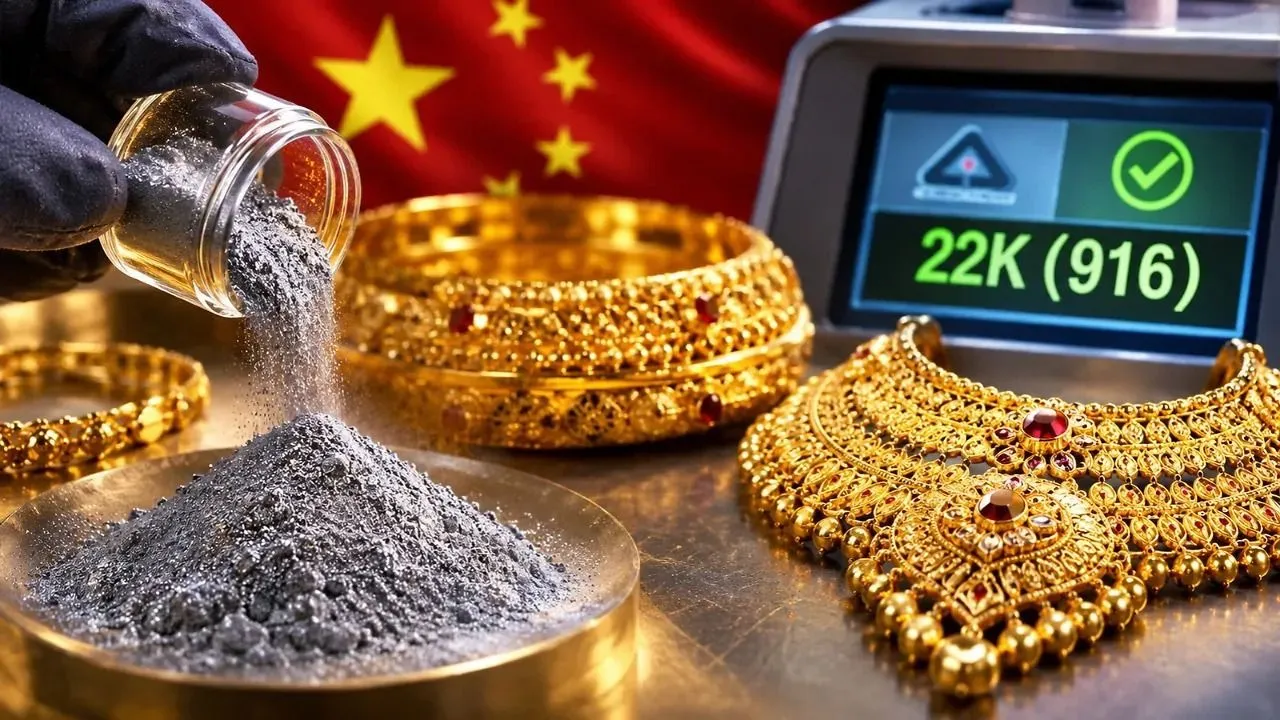
Rhenium Gold Adulteration : A new concern has emerged over gold purity in India, with a media report claiming that rhenium powder is being mixed with gold to increase its weight. Surprisingly, the alleged adulteration may not be easily detected by conventional testing methods or even some hallmarking machines. The claim has raised questions about the systems used to test gold and certify its purity. India is the world's second-largest gold consumer after China. Last year, the country imported around 640 tonnes of gold worth approximately 72.4 billion dollars. Any irregularity in gold purity in such a large market could affect consumers, jewellers and the overall trade.
What Is Rhenium Powder
Rhenium is a rare metal classified as a transition metal. Its powder is extremely dense, and its melting point is reported to be around 3,180 to 3,186 degrees Celsius. Its density is approximately 21.02 grams per cubic centimetre, which is even higher than that of gold. One of rhenium's key properties is its ability to remain stable at extremely high temperatures. This makes it useful in the aerospace industry, high-temperature superalloys, jet engine components and specialised industrial equipment. It is not an ordinary metal used for everyday purposes but a material designed for specialised technical applications.
Used Across Multiple Industries
Rhenium is not limited to aerospace applications. It is also used as a catalyst in the chemical industry and petroleum refining. In the medical sector, it plays a role in specialised components such as X-ray equipment and anode plates. Industrially, rhenium is generally available in the form of high-purity metal powder or chemical compounds such as ammonium perrhenate. Its price can be significantly high depending on its purity and quality.
Claims of Supply From China to India
According to the media report, the rhenium powder allegedly being used in India is imported from China. The report also mentions an agent based in Shenzhen, China, whose company reportedly manufactures rhenium powder. It claims that the agent has dealers in several Indian cities and that the material is being supplied through this network. However, the claims regarding rhenium being mixed with gold and its alleged widespread use require independent verification.
Challenge for Gold Testing Machines
There is not a very large difference between the densities of rhenium and gold. Rhenium has a density of approximately 21.02 grams per cubic centimetre, while gold's density is around 19.3 grams per cubic centimetre. As a result, the overall density of a mixture containing both metals may not appear significantly different. According to the report, this similarity is allegedly being exploited to mix rhenium with gold. Conventional testing may find it difficult to detect the adulteration, while modern technologies may be able to identify its presence. This increases the importance of reliable testing methods rather than relying solely on routine checks or machines when purchasing gold.
Rhenium Powder Allegedly Used to Adulterate Gold, Raising Hallmarking Concerns
TheFearless
19 Nov 2026 · 12:40 PM IST
Related Stories