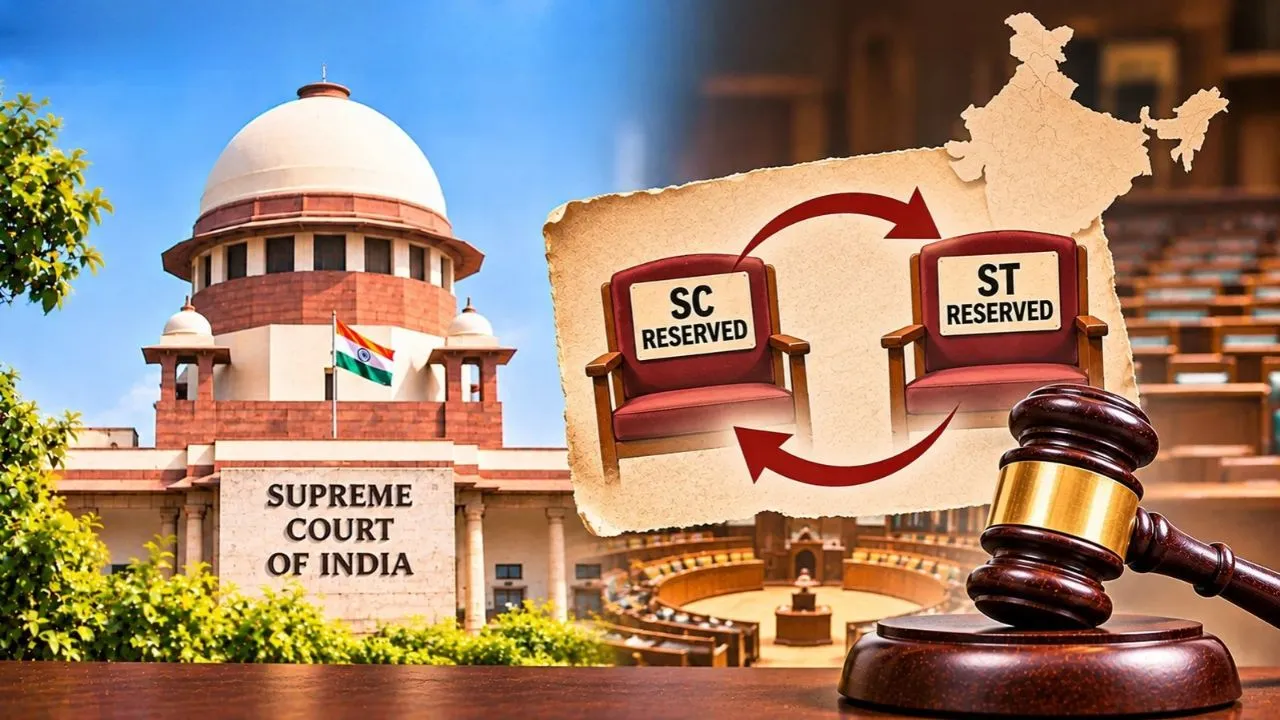
SC ST Reservation Rules : The Supreme Court has delivered an important ruling on the rotation of SC-ST reserved seats in Maharashtra's Zilla Parishad and Panchayat Samiti elections. The court clarified that no voter or candidate has an inherent right to demand that a particular constituency be reserved for SC-ST communities. Deciding when and through what process reserved seats will be rotated falls within the government's jurisdiction. Following this ruling, the ongoing dispute over the reservation system in Maharashtra's local body elections has once again come into focus.
Rotation Falls Within Government's Authority
The Supreme Court observed that the law provides for reservation of seats in local bodies in proportion to the population of SC and ST communities. It also provides for rotating reserved seats among different constituencies. However, deciding the method and timeframe for this rotation falls within the government's discretionary powers. The court made it clear that an individual's demand for their constituency to remain reserved permanently or to be declared reserved for a particular election cannot be treated as a legal right.
Justice Bagchi Explains The Legal Position
During the hearing, Justice Joymalya Bagchi made an important observation while examining the petitioner's arguments. He said that the petitioner's reasoning might appear attractive at first glance, but it overlooked the fact that no voter or candidate has an inherent right to have a particular constituency reserved. The court also clarified that reservation is determined on the basis of the proportion of SC and ST communities in the total population of the local body. Therefore, the reservation system cannot be viewed as a permanent entitlement attached to any particular constituency.
Court Upholds Rule 12 Of 2025
The Supreme Court dismissed the petition challenging Rule 12 of the Maharashtra Zilla Parishad and Panchayat Samiti (Method of Reservation of Seats and Rotation) Rules, 2025. The court said that the rule does not go against the fundamental concept of reservation or seat rotation. It also held that treating the next election after the 2025 amendment as the first election for the purpose of rotation was not incorrect. According to the court, this arrangement cannot be considered contrary to the provisions of the law.
Why The Petitioner's Argument Was Rejected
The petitioner had argued that restarting the rotation cycle could affect the chances of constituencies with smaller SC-ST populations receiving reservation in the future. This could result in certain areas being deprived of reservation benefits for a long period. However, the Supreme Court did not consider this concern sufficient grounds to declare Rule 12 unconstitutional. The ruling has clarified that the authority to determine the process and timeframe for rotating reserved seats will remain with the government.
Supreme Court's Major Ruling On SC-ST Reserved Seats: Government To Decide Rotation Rules
TheFearless
16 Nov 2026 · 3:49 PM IST
Related Stories