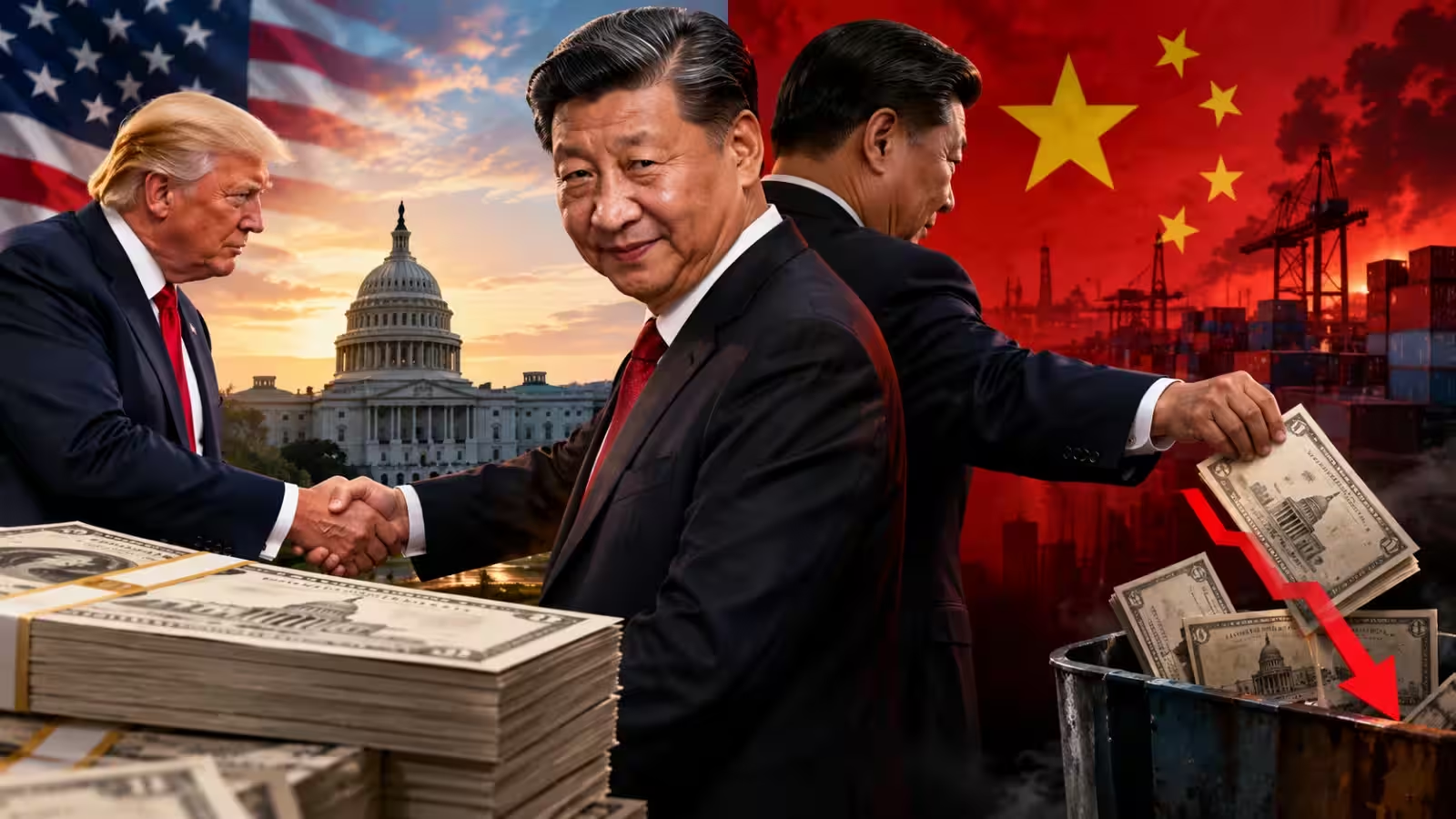
China US Treasury Holdings : Is China signalling a move away from the United States while continuing to invest in US government bonds behind the scenes? China’s reported holdings of US Treasuries are declining, while holdings attributed to countries such as Canada, Belgium and Luxembourg are increasing. This has raised questions about whether China could be investing through other countries to make its actual stake appear smaller in US records. However, these figures alone do not prove that China is pursuing a covert investment strategy.
China’s Holdings of US Treasury Bonds Decline
The economic rivalry between the United States and China has continued for years. China is trying to reduce its dependence on the US dollar and expand the role of its own currency, the yuan. Meanwhile, China’s reported holdings of US Treasury securities have declined. According to the information provided, China’s holdings fell by $27 billion in August to $591 billion, reportedly their lowest level since August 2008. However, the holdings recorded in US Treasury data may differ from China’s total beneficial investments. Therefore, these figures alone do not establish that China has completely distanced itself from US government bonds.
Rising Canadian Holdings Raise New Questions
The increase in Canada’s reported US Treasury investments has attracted attention alongside the decline in China’s holdings. According to the information provided, Canada’s holdings rose by $38 billion in August to $465 billion. Since early 2019, Canada’s reported holdings have increased by approximately $369 billion. Over the same period, China’s holdings have fallen by around $534 billion. These changes have prompted market observers to discuss whether some investments might be held through financial accounts in other countries. However, the increase in Canada’s holdings alone does not prove that Canada is investing on China’s behalf.
Suspicions Focus on Investments Through Foreign Custodians
Foreign custodians are considered important to understanding this issue. A custodian is a financial institution that holds shares, bonds and other assets on behalf of investors. If a country holds US Treasury securities through an account maintained by a financial institution in another country, public statistics may not directly identify the ultimate owner of those investments. For this reason, some observers believe China’s actual holdings could be higher than the amount officially attributed to it. However, this remains a possibility rather than a confirmed fact.
Belgium and Luxembourg Holdings Also Draw Attention
Increases in the US Treasury holdings attributed to Belgium and Luxembourg are also being examined in this context. According to the information provided, Belgium’s reported holdings rose by $20 billion in August, while Luxembourg’s increased by $6 billion. Both countries have financial services sectors and institutions that oversee investments, which has drawn attention to their reported figures. However, it would be incorrect to assume that all US Treasury bonds held through these countries belong to China. Their figures may include assets belonging to many different investors. Additional evidence would be required to substantiate claims that China is concealing its holdings.
Is China Moving Away from the US Dollar?
China has long sought to diversify its foreign exchange reserves and reduce its dependence on the US dollar. The decline in its reported US Treasury holdings could form part of this broader strategy. However, reducing direct investments in US government bonds and continuing to invest through other countries are two different things. Country-level statistics alone are insufficient to determine how many US Treasury securities China actually owns. Information about beneficial ownership and the financial institutions holding the securities is also necessary.
Why the Issue Matters in US-China Economic Rivalry
Investment in US Treasury bonds is an important part of the global financial system. The decline in China’s reported holdings raises questions about its approach to the dollar and the US economy. Meanwhile, rising holdings attributed to other countries have prompted debate about the actual owners of these investments. If China is holding assets through custodians, its beneficial ownership could differ from the figures publicly attributed to it. However, the available information does not establish that Canada, Belgium or Luxembourg are investing on China’s behalf. For now, the issue remains significant for understanding US Treasury statistics and China’s broader financial strategy.
China’s Big Move in the US? Is Beijing Routing Investments Through Other Countries to Hide Its Stake?
TheFearless
29 Oct 2026 · 5:33 PM IST
Related Stories