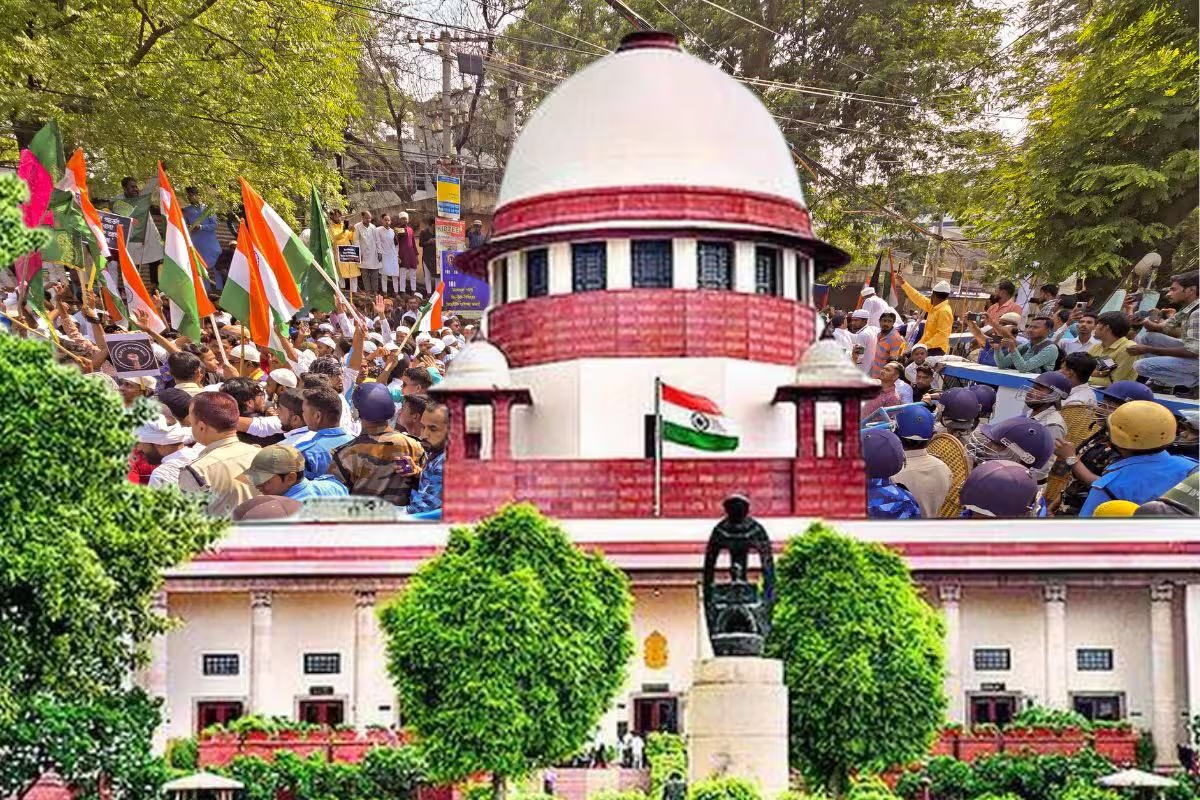
Supreme Court Protest Guidelines : The Supreme Court has made an important observation regarding protests and the prolonged occupation of public spaces in Delhi. The court clearly stated that no location can be occupied indefinitely in the name of protests. Every citizen has the right to protest, but established rules and time limits must be followed. During the hearing, the court also raised concerns about the rights of protesters, as well as the livelihoods of shopkeepers, street vendors and ordinary people.
Protests Must Have A Fixed Time Limit
During the hearing of a case related to protests in Central Delhi, CJI Surya Kant said that no individual or group can occupy a public place permanently. Other protesters also have the right to express their views. The court questioned where farmers and lawyers would go to hold their protests. It observed that designated protest venues must be allocated for specific periods and everyone must follow the prescribed rules.
Questions Raised Over Marches To Parliament
Solicitor General Tushar Mehta informed the court that permission for a protest on July 20 had been granted for only one day, but the protesters did not vacate the designated location. He also raised the issue of marching towards Parliament. Mehta said Parliament is not merely a political building and protesters cannot march there. Similarly, protesters cannot march towards the Supreme Court either.
Court Concerned About Business Losses
Appearing on behalf of traders, Mukul Rohatgi said that protests and rallies were affecting business activities. He claimed that traders had suffered losses of around Rs 2,000 crore. According to Rohatgi, reduced sales during the festive season cause significant financial losses for shopkeepers. In response, the CJI questioned how shopkeepers and street vendors would earn their livelihoods. The court said protest locations should be identified in a way that does not affect the employment of small traders.
Questions Raised Over Protests Without Permission
During the hearing, advocate Menaka Guruswamy referred to designated protest venues such as Ramlila Maidan and Jantar Mantar. She said that no violence had taken place during protests at Jantar Mantar. Meanwhile, Tushar Mehta argued that protests cannot be organised without permission if they affect the livelihoods of ordinary people. Mukul Rohatgi also said that, considering the current situation in Delhi, there is a need to explore new and better arrangements for holding protests.
Debate Also Focuses On Facial Recognition Surveillance
The hearing also addressed the surveillance of protesters and concerns over privacy. Prashant Bhushan alleged that facial recognition software was being used during protests. He questioned the government about the law under which surveillance was being conducted and who was using the collected data. In response, Tushar Mehta said that people cannot claim a right to privacy while protesting in a public place. Meanwhile, the Supreme Court has issued a notice to the Central Government on a petition filed by the Delhi Kirana Committee. The petition seeks a ban on protests in Central Delhi during the festive season.
Supreme Court's Strong Remark: Delhi Cannot Be Blocked Indefinitely In The Name Of Protests
TheFearless
3 Nov 2026 · 2:16 PM IST
Related Stories