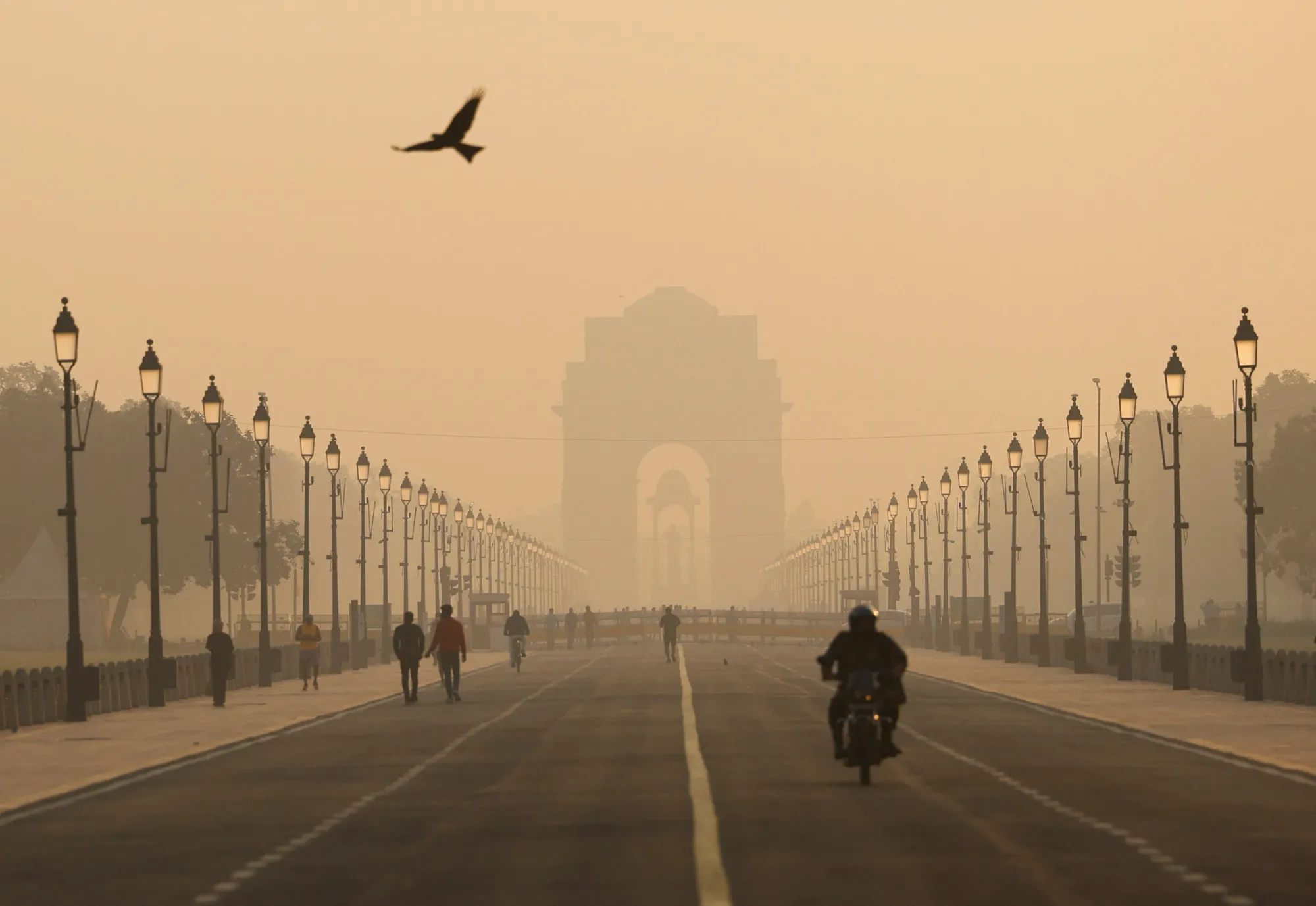
Delhi woke up to hazardous air quality on Wednesday, with the overall Air Quality Index (AQI) touching 605 at 7:41 AM, while several parts of the national capital continued to record 'severe' pollution levels. According to the Central Pollution Control Board (CPCB) data, the AQI around India Gate was recorded at 414, while Ghazipur registered 410 and Dhaula Kuan 417, all falling in the 'severe' category. Other areas also reported severe air quality, with Punjabi Bagh recording an AQI of 452, ITO 418 and RK Puram 423.
Graded Response Action Plan
Chandni Chowk recorded an AQI of 369, IGI Airport (T3) 358, Lodhi Road 304 and Vasundhara Enclave 328, all categorised as 'very poor'. Anand Vihar recorded an AQI of 300, falling in the 'poor' category. Amid the deteriorating air quality, police conducted a checking drive at the Delhi-Gurugram border as restrictions on vehicle entry came into effect under the Graded Response Action Plan (GRAP-II).
speed and the movement of air
As Delhi air quality deteriorates to the ‘Severe’ category, Union Environment Minister Bhupender Yadav said on Tuesday the Centre’s air quality panel is continuously monitoring meteorological conditions, including wind direction, wind speed and the movement of air, and assured that necessary action is being taken. The deterioration comes despite a “decline” in stubble-burning incidents compared to previous years, with the government claiming that a significant portion of paddy stubble has been utilised through ex-situ management.
stubble-burning incidents
When asked about the reduction in stubble-burning incidents in neighbouring states, including Punjab, Haryana, Rajasthan and Uttar Pradesh, Yadav said, “Yes, I have already stated that around 40 per cent of the paddy stubble has been utilised through ex-situ management this time." question on why air quality continues to remain in the severe category despite these measures, Yadav said CAQM is closely monitoring meteorological conditions and taking necessary steps based on its assessments.
Delhi's AQI reaches 605, several areas record "severe" air quality
TheFearless
4 Nov 2026 · 9:06 AM IST
Related Stories