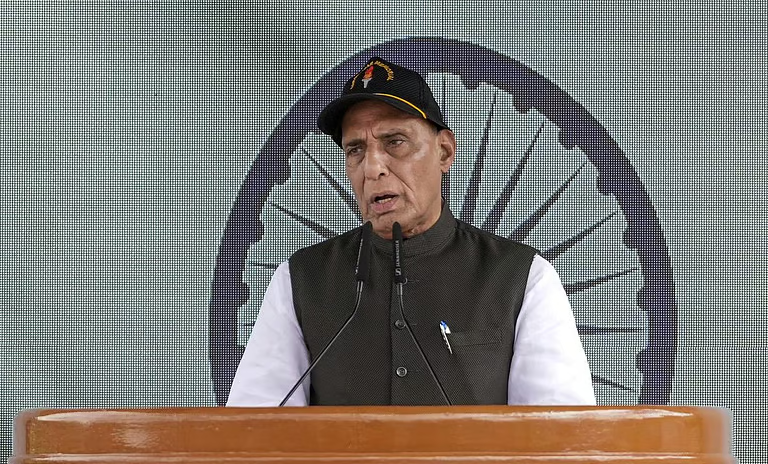
Reiterating India’s stand on cross-border terrorism, Defence Minister Rajnath Singh on Thursday asserted that any further terrorist acts originating from Pakistan would invite an even stronger response. He emphasised that while India’s cultural ethos favoured dialogue, coexistence and peaceful resolution of disputes, its commitment to peace should not be mistaken for weakness. “Operation Sindoor, Balakot Airstrikes and Surgical Strikes weren’t just military operations; they symbolised a decisive shift in the nation’s approach, moving from diplomatic condemnation to proactive action aimed at rooting out terrorism by reaching its very source,” Singh said at the Times Network Defence Conclave in New Delhi. He added that since 2014, the ‘shelf life’ of most terrorists had fallen to less than a year, with security forces neutralising them within a year of their taking up arms against India.
Our commitment to peace remains steadfast
There are no results for Defence Minister termed strength and capability as essential to maintaining peace, and underlined that India hopes for peace, but remains prepared for war that sometimes becomes necessary to protect the nation. “Our commitment to peace remains steadfast, yet we are fully prepared to confront any challenge. Our goal is to build an India that, while advocating for peace, remains vigilant when it comes to security and is fully capable of safeguarding its sovereignty, integrity, and national interests,” he said.
co-pilot who allegedly attempted to crash
On the evolving security landscape, Singh underscored the need for heightened vigilance and preparedness in an era of hybrid, high-tech and hyper warfare. He highlighted the growing complexity of security threats in the digital age, identifying what he described as the ‘5D Security Threat’-Disinformation, Destabilisation, Disruption, Deception and Destruction. He pointed out that terrorism was evolving beyond organised groups, and emerging threats include ‘lone-wolf’ attacks and ‘white-collar terrorism’, which make it increasingly difficult for security agencies to identify radicalised individuals and prevent potential attacks. The Defence Minister referred to the recent incident involving a co-pilot who allegedly attempted to crash a passenger aircraft and Captain Smit Machhar who risked his life to avert a major terror attack.
Modern defence strategies
“The incident underscored the threat posed by lone-wolf attackers while demonstrating how the courage and commitment of an individual could thwart the designs of those driven by hatred. A single alert and courageous individual could help foil an entire terrorist plot. The fight against terrorism requires not only the capabilities of security agencies but also the active participation of aware and responsible citizens,” he said. On defence preparedness, Singh underscored the need to combine ‘hard power’ with ‘soft power’ and called for a shift towards ‘smart power’. “Modern defence strategies must integrate precision-guided weapons and loitering munitions with cost-effective weaponry, human intelligence with artificial intelligence, and advanced systems with low-cost, agile and adaptable technologies to address evolving security challenges,” he said. On the growth witnessed by the defence sector due to the Government’s efforts, Singh stated that defence production has risen to a record over Rs 1.78 lakh crore from Rs 40,000 crore in 2014, with defence exports touching an all-time high of Rs 39,000 crore from Rs 686 crore in 2013-14, and India defence products reaching nearly 100 countries.
“Any terror act originating from Pakistan would invite an even stronger response”: Defence Minister Rajnath Singh
TheFearless
15 Oct 2026 · 2:42 PM IST
Related Stories