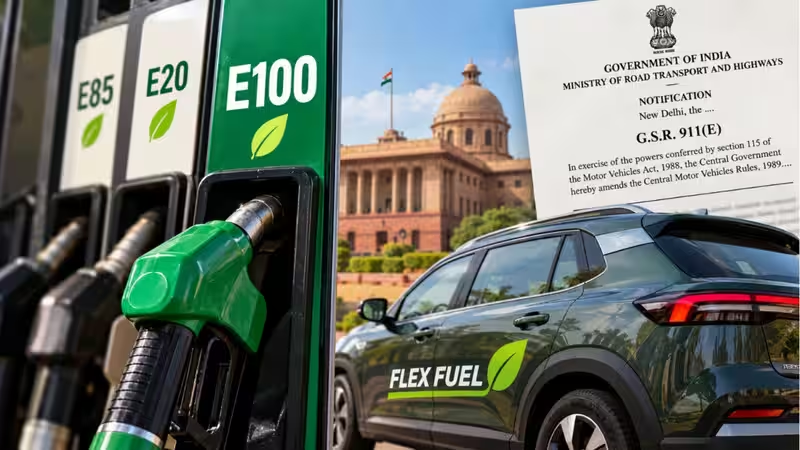
E20 vs E100 Petrol : At petrol pumps, discussions are no longer limited to fuel prices. The proportion of ethanol blended into petrol is also attracting attention. The use of E20 petrol is increasing in India, while higher-ethanol fuels such as E85 and E100 are also drawing interest. E20 contains 20% ethanol and 80% petrol. E100, on the other hand, generally contains around 92% to 95% ethanol, meaning small amounts of other substances may also be present. The difference between these fuels is not just about price but also mileage and engine compatibility.
E100 Petrol Could Have a Lower Price
Many consumers have questions about the prices of E20 and E100. According to the details provided, E20 petrol in Delhi is priced at ₹102.12 per litre. Meanwhile, E100 is estimated to cost between ₹70 and ₹75 per litre. However, this is only an estimated price and should not be treated as the current official rate applicable across India. Actual prices may vary depending on availability, location and the sales arrangement. Therefore, it would be unwise to conclude that E100 will be cheaper than E20 everywhere based solely on this estimate.
Why the Government Is Promoting Ethanol Blending
Promoting ethanol-blended fuels is not just about reducing petrol prices. The initiative also aims to reduce India’s dependence on crude oil imports and increase the use of domestically produced ethanol. Ethanol can be manufactured using sugarcane and other agricultural crops. This could help expand domestic fuel alternatives. However, the economic benefit of a fuel cannot be determined by its price per litre alone. Vehicle mileage, engine compatibility and fuel availability also play important roles.
How Much Mileage Can E100 Deliver?
Since E100 contains a much higher proportion of ethanol, the energy available per litre is lower than that of petrol. As a result, vehicles running on E100 may consume more fuel than those running on petrol. Some media reports, citing automobile experts, have suggested that mileage could decrease by as much as 35% with E100. Meanwhile, mileage reductions of around 3% to 5% have been reported in some vehicles using E20. However, the actual difference depends on the vehicle model, engine design and driving habits.
Can Every Vehicle Run on E100 Fuel?
The answer is no. A vehicle being compatible with E20 does not automatically mean it can run on E100. E100 requires a flex-fuel engine and a fuel system designed to handle high ethanol concentrations. Components such as the fuel pump, injectors and pipes must also be suitable for this type of fuel. Using high-ethanol fuel in a vehicle whose engine was not designed for it could cause problems. Therefore, always check your vehicle’s owner’s manual and follow the manufacturer’s recommendations.
Which Fuel Is Better for Your Vehicle?
Choosing between E20 and E100 requires more than comparing their prices. E20 can be used in vehicles designed to support it, while E100 requires a compatible flex-fuel vehicle. Although E100 may have a lower estimated price, it can also reduce mileage, affecting the overall cost per kilometre. If your vehicle is not designed to run on E100, avoid using it. When selecting fuel, prioritise your vehicle’s compatibility, expected mileage and the manufacturer’s instructions.
E20 vs E100 Petrol: Which Fuel Is Cheaper, Offers Lower Mileage and Suits Your Vehicle?
TheFearless
27 Oct 2026 · 2:52 PM IST
Related Stories