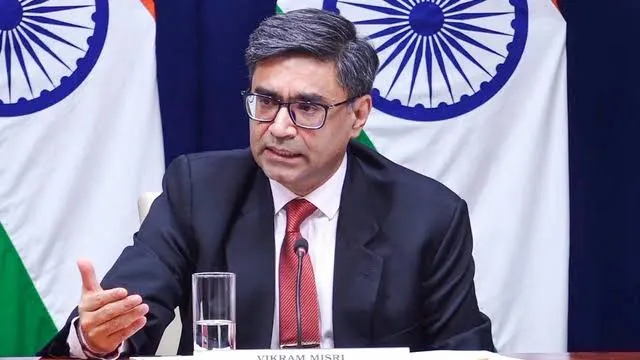
India Global Defence Partnerships : India no longer wants to limit its role in the global defence sector to simply buying and selling weapons. Instead, it is focusing on developing new technologies and manufacturing defence equipment in collaboration with other countries. Foreign Secretary Vikram Misri shared a roadmap for this strategy during the VISV-2026 programme. He explained that strategic partnerships, indigenous defence exports, capacity building, and maritime security will remain among India's key priorities over the next decade. He also discussed changing warfare technologies and India's role in the Indian Ocean region.
Defence Roadmap Prepared for the Next Decade
Foreign Secretary Vikram Misri said that India's recently released 'Defence' framework outlines the country's approach to global partnerships over the next decade. The framework focuses on strengthening strategic relationships with other countries, developing defence capabilities, and promoting exports of indigenous defence products. India's objective is to establish partnerships with different countries that deliver mutual benefits. Maritime security has also been identified as an important component of defence cooperation.
https://twitter.com/PTI_News/status/2116035183501795547
MAHASAGAR Vision to Strengthen Maritime Security
Referring to India's 'SAGAR' vision, Vikram Misri said that it is now evolving into 'MAHASAGAR'. Under this vision, India aims to strengthen its role as a first responder and net security provider in the Indian Ocean region. Being a first responder means developing the ability to provide immediate assistance during maritime emergencies or disasters. As a net security provider, India aims to contribute to the maritime security and stability of countries across the region.
Drones and AI Are Transforming Modern Warfare
The Foreign Secretary said that the nature of modern warfare is changing rapidly. Drones, artificial intelligence (AI), cyber technologies, and space capabilities have become important elements of defence strategies. These technologies have also transformed the traditional concept of deterrence. He added that the Aatmanirbhar Bharat initiative is helping India strengthen its defence capabilities. Defence production in the country has reached new levels, while Indian defence equipment is now being exported to dozens of countries.
India Wants Co-Development Partnerships, Not Just Purchases
According to Vikram Misri, India no longer wants to remain limited to the role of a buyer or seller in the global defence market. The country is developing partnerships based on co-development, co-production, and joint innovation. Efforts are also underway to expand defence cooperation with Europe, Southeast Asia, Gulf countries, and Africa. He said that India's security is closely linked to the security of its partner countries. Therefore, technology, production, and capacity building are receiving special importance in India's defence diplomacy.
Strategic Autonomy Will Guide India's Foreign Policy
The Foreign Secretary described the global strategic environment as rapidly changing and increasingly competitive. He said that conflicts, the weaponisation of supply chains, and growing competition over critical technologies are creating new challenges. In such circumstances, no country can depend solely on its geographical position or traditional alliances. India's foreign policy is based on the principles of strategic autonomy and multi-alignment. This means India will cooperate with different countries depending on specific issues while maintaining its sovereignty and freedom to make independent decisions.